In this article we will learn about some of the frequently asked Python programming questions in technical like "python import file from different directory" Code Answer's. When creating scripts and web applications, error handling is an important part. If your code lacks error checking code, your program may look very unprofessional and you may be open to security risks. An error message with filename, line number and a message describing the error is sent to the browser. This tutorial contains some of the most common error checking methods in Python. Below are some solution about "python import file from different directory" Code Answer's.

Another important topic when talking about module packages is relative imports. Relative imports are useful when importing modules within the package itself. In this case Python will look for the imported module within the scope of the package and not in the module search path.

Once you've created a useful software, packed in a module package, you might want to share it with the large Python community. After all, Python is built and maintained by the community. When importing module names, you actually load Python files stored somewhere in your file system. As mentioned earlier, the imported modules must reside in a directory, which is listed in your module search path (sys.path).

In Python there's more than these "name imports" - you can actually import a whole directory containing Python files as a module package. Modules are the highest level organizational unit in Python. If you're at least a little familiar with Python, you've probably not only used ready modules, but also created a few yourself. Modules are units that store code and data, provide code-reuse to Python projects, and are also useful in partitioning the system's namespaces in self-contained packages. They're self-contained because you can only access a module's attributes after importing it. You can also understand them as packages of names, which when imported become attributes of the imported module object.

In fact, any Python file with a .py extension represents a module. The way to move the single folder with multiple files has been shown in the previous example. But a folder or directory may contain multiple folders with multiple files also. This example shows the way to move this type of folder to another location. The os module has been imported in this script to use the rename() function that will move the content of the folder with the nested folders and multiple files.

Listdir() function is used to create a list with the files and folders of the source folder. Next, a for loop has used to iterated the list and moved the content of the source folder to the destination folder by using rename() function. The import mod2 line tells Python to search for module 'mod2' in the module search path, and therefore it's unsuccessful. The following relative import statement uses a double dot ("..") which denotes the parent of the current package ('mydir/'). The following subdir2 must be included to create a full relative path to the mod2 module.

PYTHONPATH is an environment variable which you can set to add additional directories where python will look for modules and packages. For most installations, you should not set these variables since they are not needed for Python to run. You do not have many complex methods to import a python file from one folder to another. Just create a __init__.py file to declare this folder is a python package and then go to your host file where you want to import just type. From root.parent.folder.file import variable, class, whatever.

For most beginning and intermediate programmers, working with multiple directories in Python projects can be frustrating at times. As a Python programmer, it is a best practice to abstract application code into different files and directories and according to their related functionality and data requirements. Moreover, you will have no option but to use existing packages and modules others have written. This will require the ability to work efficiently within multiple directory packages in your project. This could become a big overhead if your modules are spread across many different subdirectories, which is usually the case.

They work with importing the name of the folder itself. When a module is imported into a script, that module's __init__.py file will be sourced and executed. It provides an easy way for you to group large folders of many separate python scripts into a single importable module. The relative imports are counter-intuitive, and depending on how you start your python code, they can behave differently. In Airflow the same DAG file might be parsed in different contexts and in those cases, relative imports might behave differently. Always use full python package paths when you import anything in Airflow DAGs, this will save you a lot of troubles.

You can read more about relative import caveats inthis Stack Overflow thread. This is the easiest way to import a Python module by adding the module path to the path variable. The path variable contains the directories Python interpreter looks in for finding modules that were imported in the source files. Unfortunately, relative imports can be messy, particularly for shared projects where directory structure is likely to change. Relative imports are also not as readable as absolute ones, and it's not easy to tell the location of the imported resources.
Files from which we can import functions and objects, and packages are collections of such modules. Anyway PYTHONPATH and .pth options allow more permanent modification of the search path. Note that the module search paths are needed only for importing modules across different directories. To import files from a different folder, you need to add the Python path at runtime. To add the Python path, use the sys.path.append() method, which includes locations such as the package. The sys.path.append() is a built-in Python method used with a path variable to add a specific path for interpreters to search.

You need to add Python path runtime using the sys.path.append() method, and then it will resolve the importing file's path. With your new skills, you can confidently import packages and modules from the Python standard library, third party packages, and your own local packages. Remember that you should generally opt for absolute imports over relative ones, unless the path is complex and would make the statement too long. Using sys.path.append with an absolute path is not ideal when moving the application to other environments. Using a relative path won't always work because the current working directory depends on how the script was invoked.

Alternatively what works for me is running python3 -m app2.another_folder.another_file from root folder. The way to move a file from one location to another location with the original name has shown in the following script. The shutil module is imported in the script to use the move() function for moving the file. Path module is imported to use the exists() function for checking the given filename exists or not.

If the file exists, the destination path of the file will be defined where the file will be moved. The destination location will be printed after moving the file. If the file does not exist, then an error message will be printed.

We organize a large number of files in different folders and subfolders based on some criteria, so that we can find and manage them easily. In the same way, a package in Python takes the concept of the modular approach to next logical level. As you know, a module can contain multiple objects, such as classes, functions, etc. Physically, a package is actually a folder containing one or more module files. Import in Python helps you to refer to the code, i.e., .functions/objects that are written in another file.

It is also used to import python libraries/packages that are installed using pip, and you need then to use in your code. You now know how to import a file as a module inside another file. Let us now see how to manage the files available in folders. The files in the folders can be imported either by using absolute or relative imports. Python searches for the directories to import by going through the list.

Now if you have a package or module with the same name, then Python is going to load the module that comes first in the list and will ignore the one that comes later. So if you have name conflicts and defined files/folders with the same name, you must insert that path to sys.path at the first position. Py" extension containing Python code that can be imported inside another Python Program.

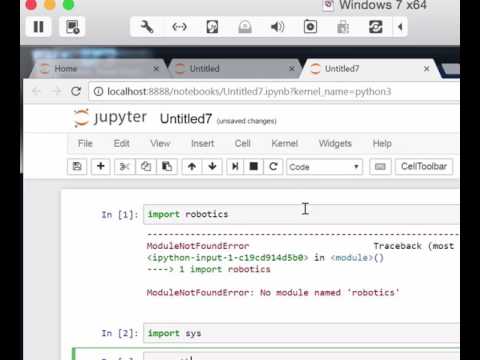
In simple terms, we can consider a module to be the same as a code library or a file that contains a set of functions that you want to include in your application. Now in other_py_file I want to import py_file, but what ever I try I give error that there is no such module. What is the way to import file from other directory?
Do I need to specify some additional imports in init .py files? In order to import a module, the directory having that module must be present on PYTHONPATH. It is an environment variable that contains the list of packages that will be loaded by Python. The list of packages presents in PYTHONPATH is also present in sys.

Path, so will add the parent directory path to the sys. Import in python is similar to #include header_file in C/C++. Python modules can get access to code from another module by importing the file/function using import.

The import statement is the most common way of invoking the import machinery, but it is not the only way. We can also import a module from an outside directory using the import library. For this, we will first have to import the importlib.util module. Then call the importlib.util.spec_from_file_location() method which takes 2 arguments file_name and file_path, which returns a value. This value will be used with importlib.util.module_from_spec() method to import a module with a specific name.

Then we can use this specific name to call the functions, classes, variables of the module. Modules are simply a python .py file from which we can use functions, classes, variables in another file. To use these things in another file we need to first import that module into that file. If the module exists in the same directory as the file, we can directly import it using the syntax import module_name. But if it exists in a different directory we cannot directly import it. In this article, we will discuss various ways in which modules can be imported from outside the directory.

The way to move a file from one location to another location by renaming the file has been shown in the following script. Shutil and path modules have been imported for moving the file and checking the existence of the file. The new name of the file has defined in the destination path of the file. If the file is moved successfully, then the file path with the new name will be printed other an error message will be printed. Save the following code as setup.py in the parent folder MyApp. The script calls the setup() function from the setuptools module.

The setup() function takes various arguments such as name, version, author, list of dependencies, etc. The zip_safe argument defines whether the package is installed in compressed mode or regular mode. During execution, when python comes across import module name, the interpreter tries to locate the module. Later in all, the directories defined inside sys.path. Despite their limited form, relative imports can be nice to use if you are dealing with a project with deeply nested sub-packages. This is most organized way of adding your custom code.

It is usually suitable when you have a separate team that manages this shared code, but if you know your python ways you can also distribute your code this way in smaller deployments. You can also install your Plugins and Provider packages as python packages, so learning how to build your package is handy. Therefore, modules in the directory containing the executed script file (.py) are searched first. Note that if there is a file with the same name as the standard library in the same directory as the executed script file, that file is imported.

The most used package type is 'wheel', although you could also provide the minimum requirement as 'source distribution/package'. Here you need to use the 'setup.py' file from the previous step. Running one of the following commands will create a 'dist/' directory in the root of your project, which contains the files to upload to PyPI.

Once all directories are found in the search path during the program startup, they are stored in a list which can be explored with sys.path in Python. Of course, you could also append a directory to sys.path, and then import your modules, which will only modify the search path during the execution of the program. One important aspect when writing modular Python apps is locating the modules that need to be imported.

While modules of the standard Python library are configured to be globally accessible, importing user-defined modules across directory boundaries can get more complicated. Environment variable, the mypy_path config or is the current working directory. Mypy will then use the relative path to determine the fully qualified module name. Computer Science, Dependency Management, Python / By Chris. The most Pythonic way to import a module from another folder is to place an empty file named __init__.py into that folder and use the relative path with the dot notation. For example, a module in the parent folder would be imported with from ..

However, it is also useful in that it makes it possible to explicitly declare that a package is closed to additional contributions. Absolute imports are preferred because they are quite clear and straightforward. It is easy to tell exactly where the imported resource is, just by looking at the statement.
Additionally, absolute imports remain valid even if the current location of the import statement changes. In fact, PEP 8 explicitly recommends absolute imports. Now that you know how import statements work, let's explore their syntax. (Note that importing a package essentially imports the package's __init__.py file as a module.) You can also import specific objects from a package or module. If the name isn't found in the module cache, Python will proceed to search through a list of built-in modules.


No comments:
Post a Comment
Note: Only a member of this blog may post a comment.